Category Archives: Talking to your employees

Content creators: beware of AI telling you what to think

Have you ever Googled your name? Of course, you have. Who doesn’t want to know about the weird and wonderful places where their name crops up online? Now, though, through the miracles of AI, you can go a step further and ask Google what it actually thinks about you.

Try it, ask it anything about yourself. I thought I’d have a go.

“Ahem, a question for Google’s AI assistant: is Sebastian St. John-Clarke any good at content creation?”

I’ve a delicate ego, so for the few seconds it took a data centre in Slough to come up with an answer, I fretted. My career is on the line here. But I need not have worried, dear reader, for the answer it came, with only good things to say:

My AI-powered testimonial
Sebastian St John Clarke is regarded as an expert in content creation specifically for B2B sectors and the insurance/reinsurance industry. With over 25 years of experience, he leads Paper Plane Communications, where his work focuses on storytelling and simplifying complex corporate messages.

His expertise is built on a “simple and engaging” philosophy, prioritising brevity and narrative over technical jargon.

B2B Specialisation: He has a strong track record of delivering communications for high-profile financial services and insurance firms.

Diverse Formats: His portfolio includes high-level copywriting for trade publications, blog creation and drafting whitepapers.

Training & Strategy: Beyond execution, he facilitates creative writing courses and idea creation workshops for corporate clients.

Buffing up my self-esteem
There was more, but I think you get the idea. AI really is a lovely, thoughtful thing and would be welcome to pen my career obituary. There is, though, more to this exercise than just a buff up of my self-esteem. Of course, all that Google knows is to repackage viewpoints that are already out there. And where did it scrape these viewpoints from? Well, from the very places where my name appears most regularly: my LinkedIn page and my own company website.

Admittedly, it’s added some verbiage that I wouldn’t write myself – I’m far too modest to say I’m “regarded as an expert” – but Google has simply recycled all the nice words it found on the internet that, by the way, I wrote in the first place. It’s saying what I’ve said about myself, but in an even more positive and flattering way.

For originality, only a human will do…
The point of this exercise? It’s not about knocking the power and uses of AI; the progress large language models like ChatGPT and Gemini have made in the last few years is incredible. It is, though, a reminder that AI assistants are not capable of being particularly objective, original or of always telling the truth. They are simply recycling the information that’s already out there.

From a content creation perspective, that’s not a bad thing if you want a first draft and would prefer AI to do the initial heavy lifting. But, by doing so, be aware that you’re not necessarily creating an objective, original or even factually true viewpoint. Only a human has the power to give you all that.

‘Damned with faint praise’ or ‘when less really is more’

While perusing the bookshelves for some unchallenging summer holiday reading, I cast aside my usual literary haunts – James Joyce’s Ulysses perhaps or maybe War and Peace – and picked up a paperback which looked like it might be a good yarn.

Rightly or wrongly, I’m often swayed by the reviews you see all over a book cover provided by whoever the publisher could persuade to say something nice about the book. In this case, I was swayed but, sadly for the author and the publishers, not into buying the book.

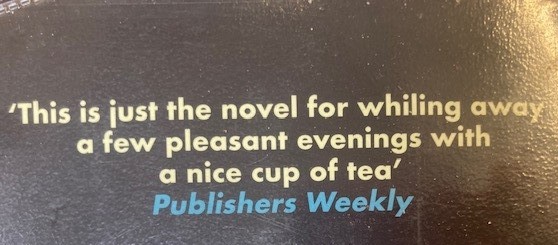
There was only one review on the cover, which read: “This is just the novel for whiling away a few pleasant evenings with a nice cup of tea”.

It seems to me that this is the equivalent of a potential house buyer looking around a house and proclaiming “nice size room” if they can’t think of anything more positive to say.

It reminds me of that old communications adage that ‘less is usually more’. In this case, it would have been better to have left the book cover to speak for itself.  

Happy holiday reading everyone – maybe even enjoy with a nice cup of tea!

Top tips for a career in communications (and one thing to never get wrong)

Somebody asked me for the best bit of career advice I could give after years of working in the communications business. I thought long and hard about it and came up with a few thoughts.…

Be curious; listen more than you speak; know your audience; tailor your messaging; keep it simple; less is more; be nice (or at least not objectionable); proof read and proof read again; don’t misspell a spokesperson’s name; be clear and concise; don’t be afraid to introduce a bit of humour; don’t be afraid to challenge those around you (and particularly those above you); the legal team might know the law but that doesn’t mean they write better than you; trust your instincts (they’re almost always right); don’t use jargon/corporate speak; if you don’t understand what’s being said, chances are most others don’t know either; and don’t let ‘busyness’ steal time needed for thinking creatively…

And then I realised, all these things are great and ‘must haves’ but ultimately it comes down to one thing:

Never – and that means absolutely never – send an email with an attachment without first opening the attachment and checking it is actually the attachment you want to send.

Have that as your bedrock and you’ll go far.

AI is not only eating a copy writer’s lunch, it’s writing about it too

In my household we’re all vegetarians and do like the odd bit of meat fakery. Interrupting our usual Quorn fest (and no, this post isn’t sponsored by the purveyors of the fine microprotein – Fusarium Venenatum – me neither!), we plucked from the supermarket shelf a chicken imposter: ‘THIS isn’t roast chicken and stuffing’.

What has this to do with my normal communications beat I hear you ask (or perhaps you’ve already disappeared to throw another juicy slab of microprotein on the skillet)?

Writing chick lit
What tickled me was the brazen use of AI to write a description of the product on the packaging. Rather than pretend a human wrote it, the THIS marketeers were quite happy to admit that they’d handed the creative pen over to our unseen AI scribes who came up with this finger lickin’ piece of chick lit:

“You could say that THIS is like the ultimate and daring undercover secret agent in the food world – dressing up in perfect disguise as pork, chicken and beef, but without any of the actual animals involved. It has a license not to kill, but to fill – your belly.”

Poking fun at AI
It’s terribly cringey as THIS themselves admit, but it made me think that a) it’s quite a good way of using AI while poking fun at it; and b) is AI literally eating the copywriter’s lunch?

To be honest, reading this poultry effort reassured me that there is still plenty of room in the coop for the human touch.

Go live blogging with your internal comms


Most decent news sites run a live blog on the biggest news stories of the day. Some will have more than one running at any one time, depending on how busy the news agenda is. Today, for example, the BBC website is running as many as four live blogs on the big stories of the day and another in the sports section focused on the Paralympics 2024 (go GB!)

Live blogs are a brilliant way of pulling together all the threads of a moving story and conveying to the reader that they’re getting the most up to date coverage of a big news event. Readers can drop in to the coverage at multiple points depending on their interest, and there is a feeling of energy and momentum around the coverage that lifts live blogs above the conventionally filed static news story.

So, if a live blog works so well for external news sites, why don’t more businesses use them as part of their internal communications?

Add some dynamism to internal communications
With the move to a hybrid working environment for many businesses, effective internal communication has taken on a critical role as the glue that holds many organisations together in the absence of more regular person-to-person contact. And live blogging can add a dynamic edge to an internal communications approach as the place an employee can go to at anytime of the day to immerse themselves in what is going on around the business.

Where is the CEO today?
Content in a live blog can range from the momentous to the minutiae: which office is the CEO visiting today? Perhaps an employee is presenting at a big industry conference. Maybe a long-termer is reaching a significant milestone and deserves a shout out. Or does a new arrival need to be announced? Perhaps it’s a big business win; an office revamp; someone attending a big industry event; a great presentation that deserves to be shared more widely…Pictures are great too and there should always be the option for people to interact and comment on content.

A compelling read
The point is a live blog can create an interesting and compelling read where people in the business feel a part of what is going on around the organisation, creating the all-important engagement that static news on the intranet does not always generate.

The hitch of course is a good live blog cannot operate by itself; it needs communications resource to curate it and contributors to send in the news and snippets that can feed the blog and keep it alive. For larger organisations, existing communications people could take turns to share the responsibility. But if a business doesn’t think it has the resources to maintain a daily live blog, why not use it as the go-to comms tool for big internal events like annual results, other earnings announcements, big structural changes?

Too often, the news feed in a company intranet feels flat and like yesterday’s news (which, most of the time, it literally is). A live blog brings more immediacy, can attract a greater readership, bring people together, and drive engagement. Oh, and it can be a lot of fun too…

Maybe it’s time for your business to start live blogging?